
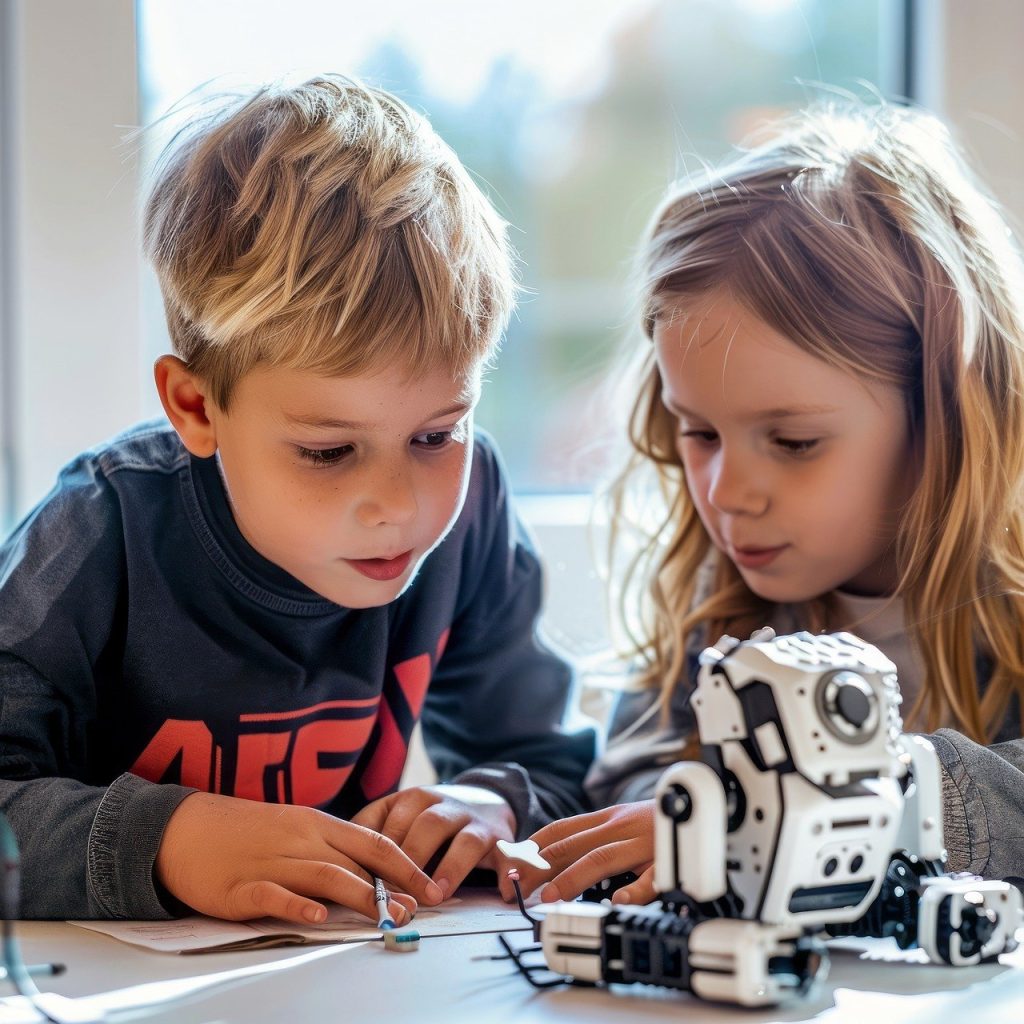
There is no doubt about it, technology has become a pivotal force in shaping how we teach and learn. From personalized learning experiences to immersive virtual environments, the integration of technology in education is not only expanding the horizons of traditional learning but also addressing diverse learning needs and styles.
This discussion delves into several groundbreaking educational technologies that have emerged in recent years. These innovations range from Artificial Intelligence (AI) tutors and chatbots, which offer tailored learning experiences, to blockchain technology that promises enhanced security and efficiency in managing educational records.
By examining the advantages and challenges of each technological solution, we aim to provide a comprehensive overview of how these tools are redefining educational paradigms and contributing to a more inclusive and effective learning environment.
Here are some new and emerging types of educational technology:
Artificial Intelligence (AI) Tutors and Chatbots:
AI tutors and chatbots can provide students with personalized learning experiences. They can adapt to a student’s individual learning style and pace, and provide feedback and support in real time.
Pros:
- Personalized learning: AI tutors can tailor their instruction to each student’s individual needs.
- Always available: AI tutors are available 24/7, so students can get help whenever they need it.
- Patient and supportive: AI tutors are never judgmental and can provide students with the encouragement they need to succeed.
Cons:
-
- Limited scope: AI tutors are currently limited in the subjects they can teach and the types of problems they can solve.
- Lack of human interaction: Some students may find that they miss the human interaction that comes with learning from a teacher.
- Bias: AI tutors can be biased if they are trained on data that is biased.


- Adaptive Learning Platforms: Adaptive learning platforms use AI to track a student’s progress and adjust the difficulty of the material accordingly. This ensures that students are always challenged but not overwhelmed.
Pros:
- Personalized learning: Adaptive learning platforms can tailor their instruction to each student’s individual needs.
- Improved engagement: Students are more likely to be engaged in learning when they are challenged at the appropriate level.
- Better outcomes: Studies have shown that adaptive learning platforms can lead to improved student outcomes.
Cons:
-
- Cost: Adaptive learning platforms can be expensive to develop and implement.
- Data privacy: There are concerns about the data that is collected by adaptive learning platforms.
- Limited content: Not all subjects are currently available on adaptive learning platforms.
- Immersive Learning with Augmented Reality (AR) and Virtual Reality (VR): AR and VR can create immersive learning experiences that allow students to explore new worlds and concepts in a way that is not possible in a traditional classroom setting.
Pros:
- Engaging and interactive: AR and VR can make learning more engaging and interactive for students.
- Improved understanding: AR and VR can help students to better understand complex concepts.
- Real-world application: AR and VR can help students to see how concepts apply to the real world.
Cons:
-
- Cost: AR and VR headsets can be expensive.
- Content availability: There is not yet a lot of educational content available for AR and VR.
- Safety concerns: There are some safety concerns about the use of AR and VR, such as motion sickness and eye strain.
- Educational Games (Gamification): Gamification is the use of game-like elements in non-game contexts. Educational games can make learning more fun and engaging for students, and can also help them to develop important skills such as problem-solving and critical thinking.
Pros:
- Motivation: Educational games can help to motivate students to learn.
- Engagement: Educational games can make learning more fun and engaging for students.
- Skill development: Educational games can help students to develop important skills such as problem-solving and critical thinking.
Cons:
-
- Distraction: Educational games can be distracting for some students.
- Cost: Educational games can be expensive to develop.
- Lack of rigor: Some educational games may not be rigorous enough to meet learning objectives.
- Blockchain in Education Blockchain is a distributed ledger technology that can be used to securely store and track educational records. This could have a number of benefits, such as reducing the risk of fraud and making it easier for students to transfer credits between institutions.
Pros:
- Security: Blockchain can be used to securely store and track educational records.
- Transparency: Blockchain can provide a transparent record of a student’s educational history.
- Efficiency: Blockchain could make it easier for students to transfer credits between institutions.
Cons:
-
- Complexity: Blockchain is a complex technology that can be difficult to understand and implement.
- Scalability: It is not yet clear how scalable blockchain is for education.
- Regulation: There is currently no regulation of blockchain in education.
Conclusion:
The exploration of new and emerging educational technologies reveals a future where learning is more personalized, engaging, and efficient.
While AI tutors, adaptive learning platforms, AR/VR, educational games, and blockchain in education present promising opportunities for enhancing learning experiences, they also bring to light significant challenges that need to be addressed, such as cost, content availability, data privacy, and the need for human interaction.
As we navigate through these technological advancements, it is crucial to balance innovation with inclusivity and ethical considerations.
The future of education lies in harnessing the power of these technologies to complement traditional teaching methods, thereby creating a more dynamic, interactive, and accessible learning landscape for students worldwide.
As technology continues to evolve, so too will the ways in which we learn and teach, promising a future of endless possibilities and transformed educational experiences.